How to Tune a Guitar for Beginners
A complete, step-by-step guide to tuning your guitar for the very first time — from learning string names to reading your tuner and keeping your guitar in tune longer.
If you've just picked up a guitar for the first time, congratulations — you're at the start of an incredible journey. But before you play a single note or chord, there is one absolute non-negotiable: your guitar must be in tune.
An out-of-tune guitar will sound wrong no matter how correctly you fret the notes, and it will train your ear to accept bad pitch. This guide will walk you through everything you need to know to tune a guitar from scratch.
What is Tuning, and Why Does it Matter?
Every string on your guitar vibrates at a specific frequency when plucked. That frequency determines the pitch — the "note" you hear. Tuning is the process of adjusting the tension of each string until it vibrates at precisely the correct frequency.
The reference standard for modern music is A440, meaning the note A in the fourth octave vibrates at exactly 440 Hz. All other notes are derived from this reference point.
When your guitar is out of tune, the notes you play clash against each other (and against any other instrument you're playing with) in a way that sounds harsh and unpleasant. Even a small deviation of 10–20 cents (hundredths of a semitone) is audible to most listeners.
Professional musicians tune constantly — between songs, between takes in the studio, and even between sections of a live performance.
Step 1: Learn the String Names
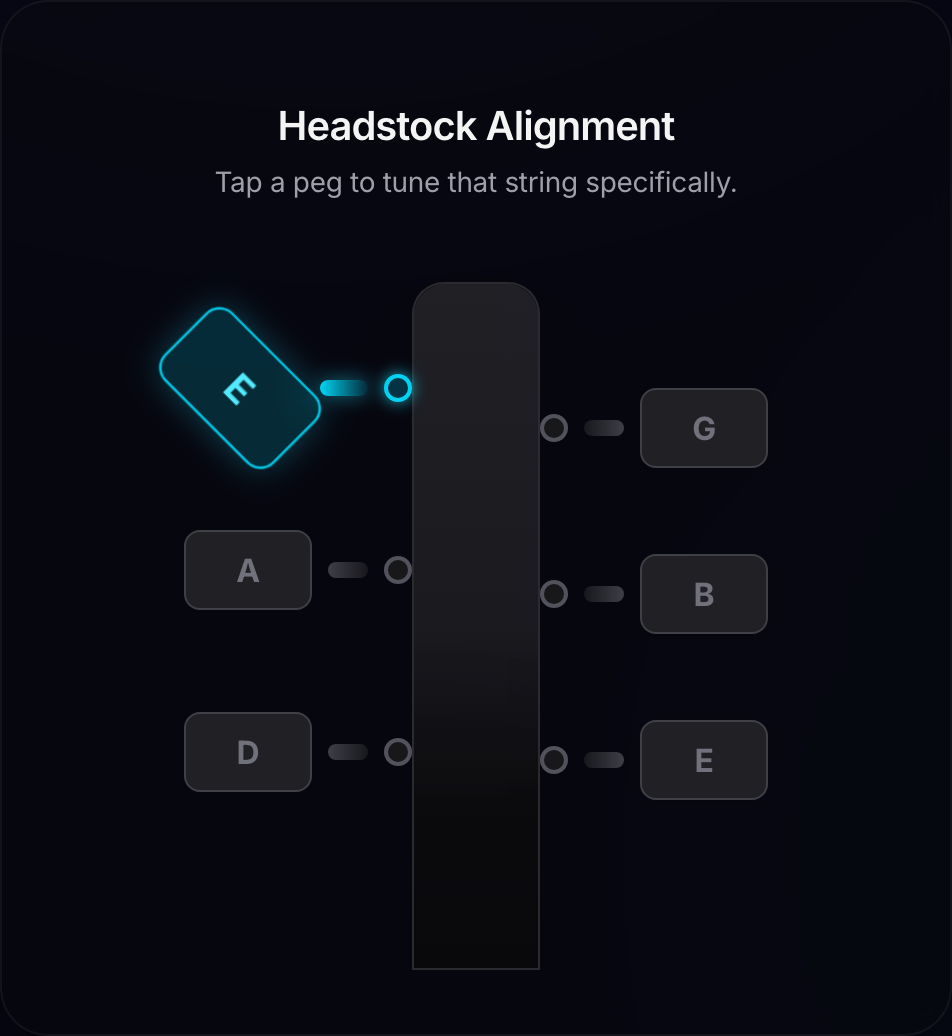
A standard 6-string guitar has strings numbered 1 through 6, where string 1 is the thinnest (highest pitch) and string 6 is the thickest (lowest pitch). When tuned to standard tuning, the open notes for each string are:
- 6th string (thickest): E2 — the lowest note, sometimes called "Low E"
- 5th string: A2
- 4th string: D3
- 3rd string: G3
- 2nd string: B3
- 1st string (thinnest): E4 — the highest note, called "High E"
A well-known mnemonic to remember the string order from low to high is: "Eddie Ate Dynamite, Good Bye Eddie." Each first letter corresponds to E, A, D, G, B, E. Another popular version is "Every Apple Does Good By Everyone." Pick whichever sticks in your head.
Step 2: Understanding Your Tuner
A tuner is a device (or app) that listens to the pitch of each string and tells you how close it is to the target note. Modern online tuners like GuitarTunePro use your device's microphone to detect the pitch in real time. Here's what you'll see:
- The Note Name: The letter being detected (E, A, D, etc.).
- The Cent Meter / Needle: A gauge showing how flat (left) or sharp (right) you are. Center means perfect pitch.
- Flat (♭): The pitch is too low. You need to tighten the string by turning its tuning peg.
- Sharp (♯): The pitch is too high. You need to loosen the string.
- Cents: A unit of pitch measurement. 100 cents = 1 semitone. Aim for 0 cents (dead center).
Step 3: Tune the Low E String (6th String)
Always start with the thickest string — the Low E. Here's the exact process:
- Open GuitarTunePro (or any tuner) and press Start.
- Pluck the 6th string cleanly with your pick or thumb. Let it ring out.
- The tuner will display the note it detects. It may not show "E" right away if the string is very far out of tune — it may detect an adjacent note first.
- Watch the needle. If it drifts left (flat), locate the tuning peg for that string on the headstock and slowly tighten it (usually counter-clockwise on the left side, clockwise on the right). Keep plucking the string every 1–2 seconds as you turn.
- If the needle drifts right (sharp), loosen the peg slightly, then retune back up to the note from below.
- Stop when the needle is centered at 0 cents and the tuner shows a solid "E". Many tuners will turn green or beep to confirm.
Step 4: Tune the A String (5th String)
Follow the exact same process for the 5th string, targeting the note A2. The tuning peg for this string should also be on the headstock — trace the string from the bridge up the neck to find which peg controls it.
Step 5: Tune D, G, B, and High E
Continue working your way from the thickest string to the thinnest, tuning each to its target note. The order is E → A → D → G → B → E. When you reach the high E (1st string), the process is identical — aim for the note E4, just two octaves above the low E.
Step 6: Do a Second Pass
This step surprises many beginners: once you tune all six strings, go back and check them all again. Why? Changing the tension of one string places slightly different stress on the guitar neck and bridge, which can pull adjacent strings slightly out of tune.
This is especially noticeable on acoustic guitars with light strings and on guitars with floating tremolo bridges.
Doing two or three full passes is completely normal. With practice, each pass will require fewer and smaller adjustments until everything sits perfectly in tune.
Common Beginner Mistakes
Tuning down instead of up
If a string is sharp, the instinct is to simply loosen it until it hits the target. But this can leave the string sitting loosely in the nut slot, causing it to slip flat while playing. Always overshoot slightly below the target, then tune up to it.
Turning the wrong peg
With 6 tuning pegs (and 12 on a 12-string), it's easy to turn the wrong one. Follow the string from the bridge all the way to the headstock before touching any peg.
Also note that on most guitars, the low E, A, and D strings have pegs on the left side of the headstock, while the G, B, and high E strings have pegs on the right.
Plucking too hard or too softly
The tuner reads the fundamental frequency of the vibrating string. If you pluck too hard, the string briefly produces a slightly sharp pitch before settling. Pluck with moderate force and wait about half a second for the reading to stabilize.
Playing in a noisy environment
Online tuners that use a microphone can pick up background noise — TV, music, other people talking. Tune in a quiet room, or hold the guitar close to your device's microphone for the most accurate reading.
Pro Tips for Keeping Your Guitar in Tune Longer
- Stretch new strings immediately: After installing fresh strings, gently pull each string away from the fretboard several times along its length, then retune. Repeat two or three times until the string stops going flat. New strings that haven't been stretched will go out of tune constantly for the first day or two.
- Lubricate the nut: The plastic or bone nut at the top of the fretboard has slots that the strings pass through. Friction in these slots causes strings to bind and slip. A tiny amount of pencil graphite rubbed into the slots dramatically improves tuning stability.
- Store your guitar properly: Temperature and humidity changes cause the wooden neck to expand and contract, pulling strings out of tune. Store your guitar at room temperature, away from radiators, air conditioning vents, and direct sunlight.
- Use good quality tuning pegs: Budget guitar machine heads can have excessive slop or backlash. If your tuner pegs feel loose or imprecise, consider upgrading to sealed-gear tuners from brands like Grover, Gotoh, or Sperzel.
- Tune before every session: Make it a habit. Even five minutes of tuning every time you pick up the guitar will significantly sharpen your pitch recognition over time.
What Comes After Tuning?
Once your guitar is in tune, you're ready to start playing. Most beginner resources will teach you a few open chords first — Em, G, C, D, Am — which are the foundation of thousands of popular songs.
As you advance, you'll explore alternate tunings like Drop D or Open G, which open up completely new sounds and playing styles.
Remember: the best guitarists in the world tune their instruments constantly. It's not a sign of being a beginner — it's a sign of taking the music seriously. Use our free online guitar tuner every time you play, and your ear will gradually learn to recognize when a string sounds even slightly off.
Ready to tune?
Use Our Free Chromatic Guitar Tuner →About the author
Manusha Dananjaya
Developer & founder, GuitarTunePro
Manusha builds web tools and started GuitarTunePro after finding most free online tuners slow, ad-cluttered, or inaccurate. GuitarTunePro's pitch detection, tuning presets, and chord library are all custom-built and verified against equal-temperament reference frequencies rather than copied from another tool.
Frequently Asked Questions
How often should I tune my guitar?
You should tune your guitar every single time you pick it up to play. Guitars go out of tune naturally due to temperature changes, humidity, and the natural elasticity of strings. Even a guitar that was perfectly in tune yesterday may need slight adjustments today.
Can I tune a guitar without a tuner?
Yes, it is possible to tune by ear using a technique called relative tuning, where you match strings to each other. However, for beginners and for accurate pitch, always use a digital tuner or an online tuner like GuitarTunePro. Your ear will improve over time.
Why does my guitar sound out of tune even after tuning?
This usually points to an intonation problem. Intonation means your guitar is only in tune at the open strings but goes sharp or flat further up the fretboard. This requires saddle adjustments at the bridge, which a guitar technician or luthier can perform.
What is 'standard tuning'?
Standard tuning is the most common tuning for a 6-string guitar. From the thickest (lowest pitch) to the thinnest (highest pitch) string, the notes are E, A, D, G, B, and E. Most beginner songs and chord charts are written for standard tuning.
Should I tune up or down to a note?
Always approach the correct pitch from below (tuning up). If a string is sharp (too high), first loosen it slightly past the target note, then tune back up to it. This ensures the string is sitting firmly in the nut slot and won't slip flat after playing.
Related Articles
Standard Tuning Explained
Why E-A-D-G-B-E is the universal standard and how the intervals work.
Why Your Guitar Goes Out of Tune
The top reasons guitars lose pitch — and exactly how to fix each one.
How to Tune a Guitar by Ear
Develop your relative pitch skills with this step-by-step ear training guide.
Best Guitar Strings for Tuning Stability
Which string brands hold their pitch the longest and why.