Alternate Guitar Tunings You Should Try
A comprehensive guide to the most popular alternate guitar tunings — what they sound like, which artists use them, and how to tune to each one.
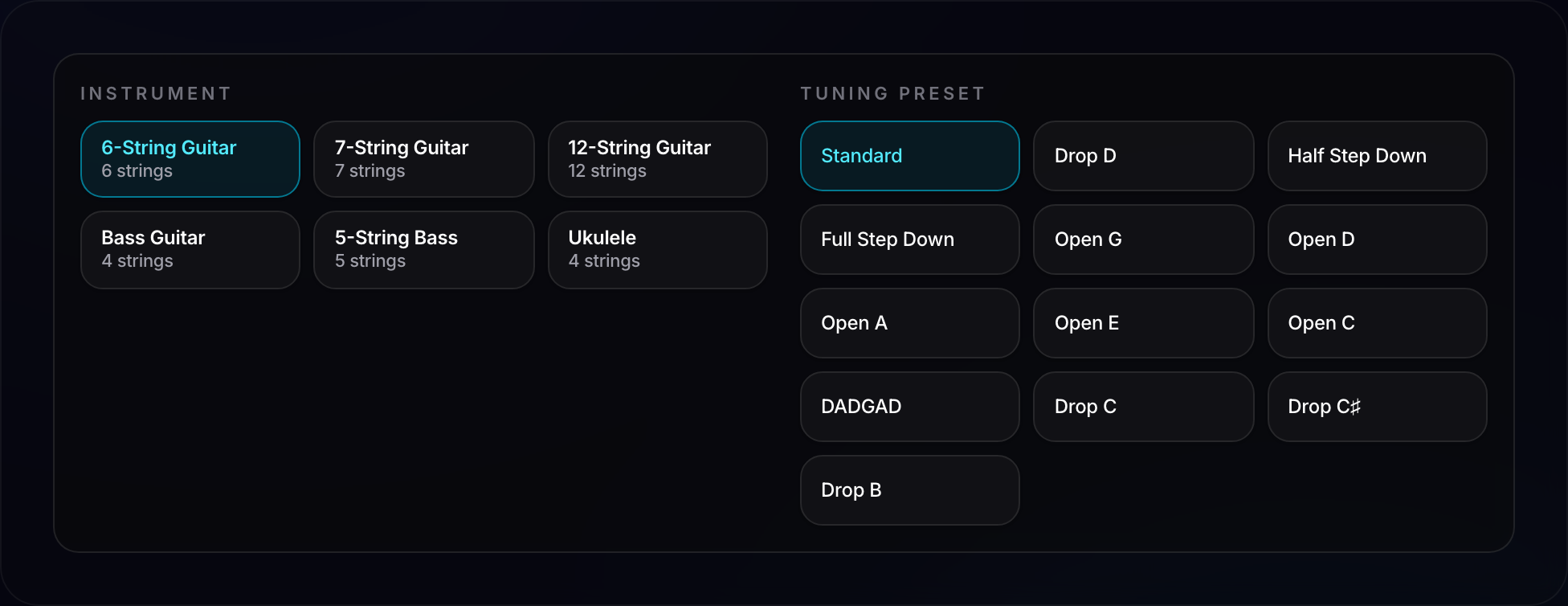
Standard tuning (E-A-D-G-B-E) is the default starting point for guitar, but it's only one of countless ways to tune the instrument. Alternate tunings change the pitch of one or more strings to create new chord shapes, drone notes, resonances, and sonic textures that are simply impossible in standard tuning.
From the chunky riffs of Drop D to the shimmering drone of Open D, each alternate tuning opens a different door into the guitar's creative potential. Here's your guide to the most important ones.
Why Use Alternate Tunings?
Every tuning shapes the physical geometry of the fretboard differently. In standard tuning, a major chord requires a specific finger pattern. In Open G, that same major chord is produced by strumming all six strings open.
This changes not just what you can play — it changes how you think about the instrument, often sparking completely new songwriting ideas.
Many legendary guitarists have built entire careers around a signature alternate tuning.
Drop D (D-A-D-G-B-E)
Drop D is the most popular alternate tuning in rock and metal. Only the 6th string is lowered from E to D — everything else stays in standard tuning. This creates one-finger power chords on the bottom three strings and adds a heavier, lower bass note.
- Best for: Rock, metal, grunge, alternative
- Famous songs: Everlong (Foo Fighters), Killing in the Name (Rage Against the Machine), Heart-Shaped Box (Nirvana)
- Key advantage: Barring the bottom three strings at any fret gives a full power chord
Read the full Drop D tuning guide for complete instructions and song examples, or go straight to our free Drop D tuner.
Open G (D-G-D-G-B-D)
Open G is one of the most beloved alternate tunings in blues, rock, and folk. The guitar is tuned so that strumming all six open strings produces a G major chord. The 6th string drops from E to D, the 5th string drops from A to G, and the 1st string drops from E to D. Use our free Open G tuner to get there instantly with your microphone.
- Best for: Blues, rock, folk, slide guitar
- Famous songs: Honky Tonk Women, Start Me Up, Brown Sugar (Rolling Stones), Little Martha (Allman Brothers)
- Key advantage: Full major chord voicings at any barre position; perfect for bottleneck/slide playing
- Keith Richards trick: Remove the low D (6th) string entirely for a 5-string Open G — this is the signature Stones guitar sound
Open D (D-A-D-F#-A-D)
Open D produces a D major chord on all six open strings, similar to Open G but built around D. It's a staple of blues and folk guitar, particularly for slide guitar playing and fingerpicking.
- Best for: Blues, folk, slide guitar, fingerpicking
- Famous songs: The Sound of Silence (Simon & Garfunkel), Big Yellow Taxi (Joni Mitchell), Fearless (Pink Floyd)
- Key advantage: Rich, drone-y fingerpicked chord voicings with the bass D string ringing under everything
Open E (E-B-E-G#-B-E)
Open E tunes the guitar to an open E major chord. Unlike Open D (which requires all strings to be at or below standard pitch), Open E raises the 3rd, 4th, and 5th strings slightly, which increases string tension.
This makes Open E less common as a dedicated guitar tuning — many slide guitarists prefer to use a capo on Open D instead, as this avoids overtensioning the strings.
- Best for: Slide guitar, blues, rock
- Famous songs: Dust My Broom (Robert Johnson, Elmore James), She Talks to Angels (Black Crowes)
- Key advantage: Allows slide guitar in the key of E (the most natural blues key) without a capo
DADGAD
DADGAD (pronounced "dad-gad") is one of the most distinctive alternate tunings in folk, Celtic, and world music. It doesn't produce a standard major or minor chord — it creates a suspended chord (Dsus4) that has an ambiguous, modal quality.
This ambiguity makes it extraordinarily versatile for droning, fingerpicking, and exotic chord voicings.
- Best for: Celtic folk, fingerpicking, world music, acoustic
- Famous songs/artists: Bron-Y-Aur Stomp (Led Zeppelin), virtually all of Pierre Bensusan's work, many Celtic folk guitarists
- Key advantage: The open strings create a lush Dsus4 drone that supports D major, D minor, and many modal scales simultaneously
Half-Step Down (Eb-Ab-Db-Gb-Bb-Eb)
Half-step down (also called "Eb tuning") lowers every string by one semitone. The guitar retains all the same chord shapes and scale patterns as standard tuning — nothing structural changes — but the entire pitch drops down by a half step.
This is one of the most commonly used "real world" alternate tunings in classic rock and metal. Use our dedicated half step down tuner to get tuned up instantly.
- Best for: Rock, metal, singers who need a lower key
- Famous songs: Purple Haze (Jimi Hendrix), Welcome to the Jungle (Guns N' Roses), November Rain (Guns N' Roses), Symphony of Destruction (Megadeth)
- Key advantages: Slightly lower string tension makes string bending easier; allows singers to play in standard-shaped chords but transpose the key down a half step for comfort
Full-Step Down (D-G-C-F-A-D)
Dropping every string a full step creates even lower tones and further reduces string tension. Like half-step down, all standard chord shapes still work, but everything sounds a whole step lower.
This tuning became popular in heavy metal and alternative rock bands who wanted a darker, heavier sound without exploring drop tunings.
- Best for: Metal, heavy rock, vocalists needing lower keys
- Famous artists: Alice in Chains (many tracks), Soundgarden, Stone Temple Pilots
- Key advantage: Very loose string tension creates an elastic, "thick" attack; deeper, darker tonal character
Open A (E-A-E-A-C#-E)
Open A produces an A major chord on the open strings. It's a favorite of blues slide guitarists and is also used in some Appalachian folk styles. The open A strings create a powerful drone quality.
- Best for: Blues slide, country, folk
- Famous artists: Bonnie Raitt (slide guitar), many Delta blues players
Nashville Tuning (High Strung)
Nashville tuning isn't really an alternate tuning in the traditional sense — it's standard E-A-D-G-B-E but with the low four strings replaced by octave-higher strings (the same thin strings used for the high end of a 12-string guitar).
When played alongside a standard guitar, it creates a brilliant, shimmering 12-string-like effect without the complexity of an actual 12-string. It's a studio production staple.
How to Tune to Any Alternate Tuning
The easiest way to tune to any alternate tuning is to use a chromatic tuner that shows all notes, not just standard E-A-D-G-B-E. GuitarTunePro is a chromatic tuner that detects whatever note your string is producing, making it simple to tune each string to its required pitch for any alternate tuning.
When retuning multiple strings significantly (especially downtuning), retune from the lowest (heaviest) string to the highest, then do a second pass — detuning one string changes the overall neck tension, which slightly affects all the others.
Tips for Exploring Alternate Tunings
- Start with Drop D: It changes only one string and immediately opens up rock riff possibilities.
- Keep a second guitar in alternate tuning: Constantly retuning a single guitar is tedious. A second guitar kept in Open G or half-step down lets you switch instantly.
- Heavier strings for lower tunings: Dropping pitch reduces tension. Use 11s or 12s for full-step-down or open tunings to maintain playability.
- Explore, don't just copy: The real power of alternate tunings is discovering chord shapes that don't exist in standard tuning. Run your fingers around the fretboard in Open G and you'll stumble onto voicings you'd never find otherwise.
Ready to explore? Use our free online chromatic guitar tuner to tune to any of these alternate tunings in seconds — it detects any note and works directly in your browser with no download required.
Ready to tune?
Use Our Free Chromatic Guitar Tuner →About the author
Manusha Dananjaya
Developer & founder, GuitarTunePro
Manusha builds web tools and started GuitarTunePro after finding most free online tuners slow, ad-cluttered, or inaccurate. GuitarTunePro's pitch detection, tuning presets, and chord library are all custom-built and verified against equal-temperament reference frequencies rather than copied from another tool.
Frequently Asked Questions
What is the most popular alternate guitar tuning?
Drop D (D-A-D-G-B-E) is the most widely used alternate tuning, especially in rock, metal, grunge, and alternative music. It requires only changing one string from standard tuning and unlocks one-finger power chords. After Drop D, Open G (D-G-D-G-B-D) and Half-Step Down (Eb-Ab-Db-Gb-Bb-Eb) are also extremely common.
Does using an alternate tuning damage my guitar?
Standard alternate tunings will not damage your guitar. Tunings that are much lower than standard (multiple whole steps down) can reduce string tension significantly and may cause the neck to shift slightly due to reduced tension. Always use appropriate string gauges for your chosen tuning, and allow the guitar to acclimate if you tune very low.
Can I use a standard tuner for alternate tunings?
Yes, as long as you use a chromatic tuner that can detect any note, not just E-A-D-G-B-E. GuitarTunePro is a chromatic tuner that can detect any pitch, so you can tune each string to its target note individually. Many tuners also have preset alternate tuning modes built in.
What open tuning is best for slide guitar?
Open E (E-B-E-G#-B-E) and Open D (D-A-D-F#-A-D) are the traditional favorites for slide guitar. Both produce a full major chord when strummed open, allowing the slide to produce clean major chords at any fret. Open G is also very popular for slide, particularly in blues and rock.
What tuning does Keith Richards use?
Keith Richards of The Rolling Stones is famously associated with Open G tuning (G-D-G-B-D) — played on a 5-string guitar with the low E string removed. This tuning underpins some of the Stones' most iconic songs including Honky Tonk Women, Start Me Up, Brown Sugar, and Gimme Shelter.
Related Articles
Drop D Tuning Guide
The complete guide to Drop D tuning for rock and metal.
Standard Tuning Explained
Understand why E-A-D-G-B-E is the universal standard.
Does a Capo Affect Guitar Tuning?
How capos interact with your tuning and how to compensate.
How to Use a Chromatic Tuner
How to use a chromatic tuner for any alternate tuning.