Drop D Tuning Guide for Rock and Metal
Everything you need to know about Drop D — from how to tune to it in seconds, to the one-finger power chord technique that changed rock guitar forever.
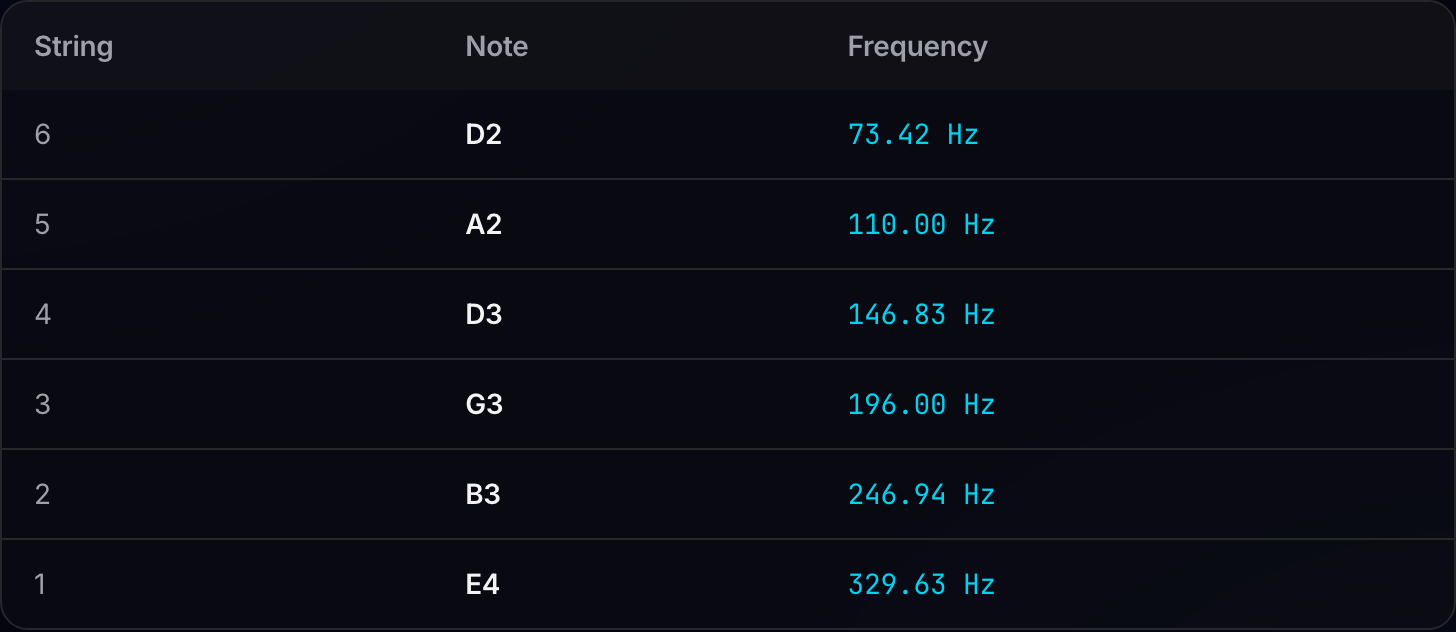
Drop D is the gateway drug of alternate tunings. It requires changing only one string — the low E drops down a whole step to D — yet it completely transforms what you can play on the guitar.
For rock, metal, grunge, and alternative music, Drop D unlocks one-finger power chords, heavier bass tones, and the signature "chug" sound that defines a generation of guitar riffs.
If you've never explored alternate tunings, Drop D is the perfect place to start.
What Exactly Is Drop D Tuning?
In standard tuning, the strings are tuned E-A-D-G-B-E from thickest to thinnest. Drop D changes only one thing: the 6th string (the thickest) is lowered by exactly one whole step (two semitones) from E2 to D2.
Only the 6th string changes — from E down to D.
That's it. The remaining five strings — A, D, G, B, and high E — stay exactly where they are. Despite being a minimal change, the sonic and ergonomic impact is massive.
How to Tune to Drop D
Method 1: Use an Online Tuner (Fastest)
Open our free Drop D tuner — select "Drop D" from the tuning mode options. The tuner will show the target note D for the 6th string. Pluck the low E string and loosen the tuning peg until the tuner reads D at 0 cents. Done — the whole process takes about 10 seconds.
Method 2: Octave Method (Recommended)
The open 4th string is D3. Your target for the 6th string is D2 — exactly one octave lower. Pluck both strings simultaneously and loosen the 6th string's tuning peg until they ring as the same note an octave apart. You'll hear a clean, locked-in unison octave when they're in tune. This is the most reliable ear-based method because the two strings share a note name, so any mismatch is obvious.
Method 3: Fretted Fifth Method
This ear-based method uses the 5th string as a fixed reference — no harmonics required, just a fretted note:
- Play the open 5th string (A2) and let it ring.
- Fret the 6th string at the 7th fret and pluck it. In standard tuning this note is B2 — clearly sharp of the open A.
- Slowly loosen the 6th string tuning peg while plucking both notes together, listening for the fretted note to drop into unison with the open A string.
- Stop when they match exactly. A perfect fifth sits 7 semitones above its root, and D2 + 7 semitones = A2 — so once the 6th string is correctly dropped to D, its 7th fret will always match the open 5th string.
The One-Finger Power Chord — The Game Changer
In standard tuning, a power chord (root + fifth interval) on the low strings requires barring across two strings at slightly different frets — or using index and ring fingers in an angled position. It's a manageable technique, but rapid chord changes require precise finger movement.
In Drop D, because the 6th string is tuned down a whole step, the power chord shape becomes a straight line. You bar across the 6th, 5th, and 4th strings all at the same fret with a single finger. The D, A, and G strings in Drop D align to produce a root-fifth-octave voicing automatically.
- D power chord (open): Play strings 6, 5, 4 open → D5
- E power chord: Barre strings 6, 5, 4 at the 2nd fret → E5
- F power chord: Barre at the 3rd fret → F5
- G power chord: Barre at the 5th fret → G5
- A power chord: Barre at the 7th fret → A5
This single-finger system allows you to change between power chords with lightning speed. Slide the finger up and down the fretboard without lifting — which is exactly how the iconic machine-gun riffs in metal and grunge are played.
Why Drop D Sounds Heavier
Lowering the pitch of the 6th string to D2 (82.41 Hz → 73.42 Hz) produces a few distinct effects that combine to create the "heavy" sound:
- Lower fundamental frequency: The extra-low D adds more physical bass presence, especially through a guitar amp at high gain.
- Reduced string tension: A looser string moves more freely, which creates a slightly fatter, more elastic attack.
- Palm muting characteristics: A slacker string responds more dramatically to palm muting near the bridge, creating the distinctive "chug" that defines metal rhythm guitar.
- Open D drone: The open D2 resonates sympathetically with many chords played further up the neck, adding thickness to the overall sound.
Famous Songs in Drop D Tuning
Some of the most iconic guitar riffs in history were written in Drop D:
- Everlong — Foo Fighters: The opening riff uses the open D string as a pedal note against moving chords — impossible to execute as cleanly in standard tuning.
- Killing in the Name — Rage Against the Machine: Tom Morello's iconic breakdown riff exploits the open D string and rapid power chord slides.
- Heart-Shaped Box — Nirvana: Kurt Cobain used Drop D for the heavy, distorted main riff while the clean verse floats above.
- Black Hole Sun — Soundgarden: Chris Cornell used Drop D for the eerie open-tuned chords in this grunge classic.
- Moby Dick — Led Zeppelin: Jimmy Page's acoustic intro uses Drop D for the ringing low D bass note.
- The Pretender — Foo Fighters: Another Grohl Drop D track with pounding D5 power chords.
- Aerials — System of a Down: The atmospheric verses and crushing chorus all live in Drop D.
String Gauge Considerations for Drop D
When you drop the 6th string from E to D, you reduce its tension. On a standard 10-gauge set (10-46 or 10-52), the low string becomes noticeably looser — it may feel floppy, buzz against the frets when played hard, or not palm-mute cleanly.
Players who spend most of their time in Drop D (or lower drop tunings) often use:
- "Skinny Top, Heavy Bottom" sets (e.g., 10-52 or 10-60): Light gauges on the high strings for lead playing, heavy gauges on the low strings for tuning stability.
- 11 or 12 gauge sets: A standard heavier set maintains better tension across all strings in Drop D and lower tunings.
- Mixed/custom gauges: Many guitarists build custom sets — keeping 10-42 on strings 1–5 but substituting a 52 or 56 for the 6th string.
For string recommendations by brand and material, see our dedicated guide.
Drop D Variants: Going Even Lower
Drop D opened the door to even lower drop tunings, which became popular in metal subgenres:
- Drop C (C-G-C-F-A-D): Drop D shifted down a whole step. Used extensively in metalcore.
- Drop B (B-F#-B-E-G#-C#): Popular in heavier metal styles for extreme heaviness.
- Drop A (A-E-A-D-F#-B): Used on 7-string guitars dropped further for extreme metal.
Each lower tuning requires progressively heavier string gauges to maintain playable tension. Many guitarists dedicate separate guitars for each tuning rather than constantly retuning.
Switching Between Standard and Drop D Live
When a setlist requires switching between standard and Drop D songs, guitarists have a few options:
- Dedicated Drop D guitar: Keep a second guitar tuned to Drop D and switch instruments between songs.
- D-Tuner (Hipshot): A mechanical tuning device that replaces your tuning peg and allows you to flip a lever to drop the 6th string exactly one whole step and back. Instant, accurate, and reliable — used by countless touring guitarists.
- Retune manually: With practice, dropping the low E to D by ear takes about 5 seconds. Use the octave method described above.
Drop D is one of the most rewarding alternate tunings to learn precisely because the payoff is immediate. Within minutes of tuning down, you'll be playing riffs that felt difficult in standard tuning with effortless one-finger shapes.
Tune down with GuitarTunePro, dial in some gain, and start riffing.
Ready to tune?
Use Our Free Chromatic Guitar Tuner →About the author
Manusha Dananjaya
Developer & founder, GuitarTunePro
Manusha builds web tools and started GuitarTunePro after finding most free online tuners slow, ad-cluttered, or inaccurate. GuitarTunePro's pitch detection, tuning presets, and chord library are all custom-built and verified against equal-temperament reference frequencies rather than copied from another tool.
Frequently Asked Questions
What strings are in Drop D tuning?
Drop D tuning is D-A-D-G-B-E from the thickest string to the thinnest. Only the 6th string (Low E) is changed — dropped down a whole step from E to D. All other five strings remain exactly the same as standard tuning.
How do I quickly tune from standard to Drop D?
The most reliable ear-based method: pluck the open 4th string (D3) and the open 6th string together, then loosen the 6th string tuning peg until it rings a clean octave below the 4th string. You can also fret the 6th string at the 7th fret and loosen it until that note matches the open 5th string (A2) — once correctly tuned to D2, the 7th fret sits a perfect fifth above, which is A2. For an instant, exact reading, use the free GuitarTunePro online tuner set to Drop D mode.
What is the Drop D power chord shape?
In Drop D, a power chord is played by barring all three low strings (6th, 5th, and 4th) at the same fret with one finger. This is different from standard tuning where a power chord requires two fingers in an angled position. The Drop D power chord sounds thicker because all three strings create a root-fifth-root voicing.
What famous songs use Drop D tuning?
Famous songs in Drop D include: Everlong by Foo Fighters, Killing in the Name by Rage Against the Machine, Heart-Shaped Box by Nirvana, Black Hole Sun by Soundgarden, Moby Dick by Led Zeppelin, The Pretender by Foo Fighters, and Aerials by System of a Down.
Is Drop D tuning good for acoustic guitar?
Absolutely. Drop D is excellent on acoustic guitar. It allows for open D bass drone notes that create a rich, resonant sound. Many folk, country, and fingerstyle guitarists use Drop D to facilitate low D drones and open chord voicings that aren't possible in standard tuning. Artists like Neil Young and Led Zeppelin famously used Drop D on acoustic tracks.
Related Articles
Alternate Guitar Tunings You Should Try
Open G, DADGAD, half-step down, and more alternate tunings explored.
Standard Tuning Explained
Understand the E-A-D-G-B-E intervals and why they work.
Best Guitar Strings for Tuning Stability
Which string gauges work best for drop tunings.
How to Use a Chromatic Tuner
Master your tuner for any tuning, not just standard.